Goal program
Athlete Mode
Get strong, move well, and stop running out of gas.
- 3 days a week
- 10 weeks
- Any level
- For everyone
- Gym
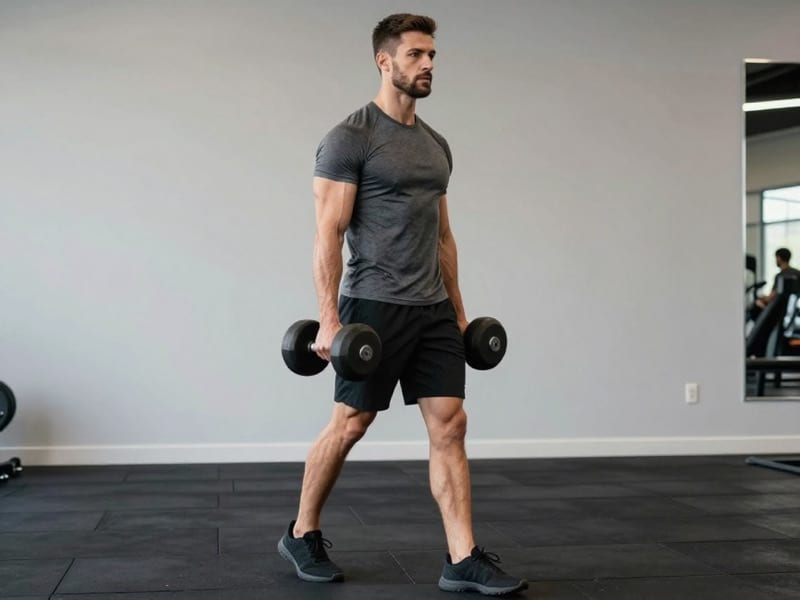
About this program
Three full-body sessions a week built from the same blocks: a heavy lift, single-leg work, a push-pull superset, core and carries, then intervals on two days and an easy incline walk on the third. Keep 1–3 reps in reserve (2–3 if you are new) and add weight only after you hit the top of the rep range on every set. In 10 weeks, expect clearly stronger lifts, better balance and conditioning, and steady but modest muscle gain.
Who it’s for
- Any level: beginners start with fewer sets and lighter weights, as the notes explain.
- For everyone.
- A gym with machines, cables and free weights.
- 3 sessions a week, about 70 minutes each.
- 8–10k steps a day on top of the workouts.
The week
Warm up for 5–7 minutes first. Rest is the pause between sets. A1 and A2 (B1 and B2) are supersets: do one set of each back to back, then rest. Rest days: walk and recover.
Monday Squat day: Squat, Bench & Sprints
Heavy squats, a bench press and pull-up superset, reverse lunges, a farmer's carry with core work, and bike sprints. · about 70 min
| Exercise | Sets × reps | Rest |
|---|---|---|
| Barbell Back SquatHeavy but clean. For the first 2 weeks, stop with 2–3 reps left; after that, 1–2 (beginners stay at 2–3). New to barbell squats? Do goblet squats for 3 × 8–10 instead. | 4 × 4–6 | 3 min |
| A1 Barbell Bench PressFeet planted, shoulder blades pinned back; use the rack's safety arms or a spotter. Once you get 6 clean reps on every set, add 5 lb. New to the barbell? Use dumbbells for 8–10 reps. If you'd lose the bench in a busy gym, do straight sets. | 4 × 4–6 | — |
| A2 Assisted Pull-UpGo straight from the bench, then rest 2 min before the next bench set. Set the assist so 6–10 reps are hard and use less of it over time. The goal is real pull-ups. | 4 × 6–10 | 2 min |
| Reverse LungeStep back, lower the back knee close to the floor, and push up through the front heel. Hold dumbbells once bodyweight gets easy. | 3 × 8 per leg | 90 s |
| B1 Farmer's WalkUse the heaviest dumbbells you can carry standing tall without leaning. Brace your abs and take short, quick steps. | 3 × 40 steps | — |
| B2 Dead BugKeep your lower back glued to the floor. Breathe out fully as the arm and leg reach away. It also helps you catch your breath after the carry. | 3 × 8 per side | 90 s |
Cardio after: Stationary Bike, 6 × 30 s hard / 90 s easy. Bike intervals: spin easy for 2 min, then do 6 rounds of 30 s hard and 90 s easy. Hard means too hard to talk, while your pedaling stays smooth. New to intervals? Start with 4 rounds.
Wednesday Hinge day: Hinge, Split Squat & Stairs
Hamstrings and glutes, split-squat balance, overhead press and rows, hanging knee raises and side planks, stair intervals. · about 65 min
| Exercise | Sets × reps | Rest |
|---|---|---|
| Romanian DeadliftPush your hips back, keep the bar against your legs and your knees slightly bent. Lower until your hamstrings are fully stretched while your back stays flat. New to it? Start with dumbbell RDLs. | 4 × 6–8 | 2.5 min |
| Bulgarian Split SquatBack foot on a bench, most of your weight on the front leg. Start with bodyweight, then add dumbbells. Hold a rack for balance if you need to. | 3 × 8 per leg | 90 s |
| A1 Seated Dumbbell Shoulder PressSit tall and press up and slightly in. Don't arch your lower back. | 3 × 6–10 | — |
| A2 One-Arm Dumbbell RowPull your elbow toward your hip and pause for 1 second at the top. | 3 × 8–12 per arm | 90 s |
| Lying Leg CurlKeep your hips pressed into the pad. Curl up fast and lower slowly over 2–3 seconds. It balances all the squats and lunges and keeps your hamstrings strong for sprints. | 3 × 8–12 | 60 s |
| B1 Captain's Chair Knee RaiseCurl your pelvis up rather than just lifting your knees, and don't swing. To make it harder, straighten your legs. | 3 × 10–15 | — |
| B2 Side PlankKeep a straight line from head to feet. To make it easier, do it from your knees. | 3 × 30–45 s per side | 60 s |
Cardio after: StairMaster, 10 min: 1 min fast / 1 min easy. StairMaster intervals: alternate 1 fast minute with 1 easy minute for 10 minutes. Hold the rails lightly or not at all.
Friday Hips & carries: Hip Thrust, Step-Ups & Carries
Hip drive, single-leg step-ups, incline press and rows, shoulder health, a suitcase carry and an easy aerobic walk. · about 70 min
| Exercise | Sets × reps | Rest |
|---|---|---|
| Barbell Hip ThrustUpper back on a bench, chin tucked, pad on the bar. Lock out your hips fully and squeeze for 1 second at the top. New to it? Start with just the bar. | 4 × 6–10 | 2 min |
| Dumbbell Step-UpUse a box about knee height. Drive through the front foot only and control the way down. | 3 × 8 per leg | 90 s |
| A1 Incline Dumbbell PressSet the bench at about 30°. Lower the dumbbells until you feel a deep stretch in your chest. | 3 × 8–12 | — |
| A2 Seated Cable RowKeep your chest up and pull to your belly. On the way back, let your shoulder blades stretch forward. | 3 × 8–12 | 90 s |
| B1 Face PullRope at eye level; pull your hands apart and back. Go light and strict. It's for posture and healthy shoulders. Use both sides of a cable crossover so you can go straight into the crunch. | 3 × 12–15 | — |
| B2 Cable CrunchKneel and curl your ribs toward your hips while your hips stay still. Use moderate weight. | 3 × 10–15 | 60 s |
| Farmer's WalkSuitcase carry: hold one heavy dumbbell in one hand and walk without leaning, then switch hands. It trains your obliques and grip. | 3 × 40 steps per hand | 60 s |
Cardio after: Incline Treadmill Walk, 15–20 min, 8–12% incline. Build your aerobic base: walk briskly at a pace where you can still talk. It builds endurance and helps recovery without beating up your joints.
How to progress
- Double progression: add reps within the range first. When every set reaches the top of the range with clean form, add a little weight (about 5–10 lb on lower-body lifts, 2.5–5 lb on upper-body lifts) and start again at the bottom.
- Stop most sets 1–2 reps short of failure. Beginners stop 2–3 reps short for the first weeks.
- Every 6–8 weeks, or when you feel run down, take an easier week: half the sets, same weights.
Food
Eat at maintenance, or in a small 5–10% surplus if you want to add muscle, with 1.6–2.2 g of protein per kg of body weight (about 0.7–1 g per lb) spread over 3–5 meals.
Find your numbers with the free TDEE calculator, the macro calculator and the protein calculator.
Similar programs
-
 Movie-star plan
Action HeroBig shoulders, chest and arms on a lean body5 days/wk · 12 wks · Intermediate · Men
Movie-star plan
Action HeroBig shoulders, chest and arms on a lean body5 days/wk · 12 wks · Intermediate · Men -
 Movie-star plan
Action HeroineStrong, athletic, toned4 days/wk · 12 wks · Intermediate · Women
Movie-star plan
Action HeroineStrong, athletic, toned4 days/wk · 12 wks · Intermediate · Women -
Movie-star plan
Lean & ShreddedShredded for a role: circuits and daily cardio5 days/wk · 8 wks · Intermediate · Everyone
-
 Model plan
Swimsuit ModelLean and toned: glutes, a flat waist and great posture4 days/wk · 8 wks · Intermediate · Women
Model plan
Swimsuit ModelLean and toned: glutes, a flat waist and great posture4 days/wk · 8 wks · Intermediate · Women