Goal program
Pure Strength
Heavy squat, bench, RDL and pull-ups: strength you can measure.
- 3 days a week
- 12 weeks
- Intermediate
- For men
- Gym
About this program
Three full-body days built on the squat, bench press, Romanian deadlift, rows and pull-ups: heavy sets of 3–6 reps with 2–3 minutes of rest, stopping 1–2 reps short of failure, plus one short hypertrophy superset at the end of each day. The key rule: once you hit the top of the rep range on every set, add weight (5 lb / 2.5 kg on bench, 5–10 lb / 2.5–5 kg on squat and RDL), and take an easy week at half the sets around weeks 6 and 12, or whenever a lift stalls for two weeks. With a few years of training behind you, a realistic 12-week result is roughly 5–10% more on your main lifts; newer lifters progress faster.
Who it’s for
- You already train regularly and want more volume and intensity.
- Written with men in mind; anyone can follow it.
- A gym with machines, cables and free weights.
- 3 sessions a week, about 70 minutes each.
- 7–10k steps a day on top of the workouts.
The week
Warm up for 5–7 minutes first. Rest is the pause between sets. A1 and A2 (B1 and B2) are supersets: do one set of each back to back, then rest. Rest days: walk and recover.
Monday Squat: Heavy Squat Day
Heavy squat, paused bench, cable rows · about 70 min
| Exercise | Sets × reps | Rest |
|---|---|---|
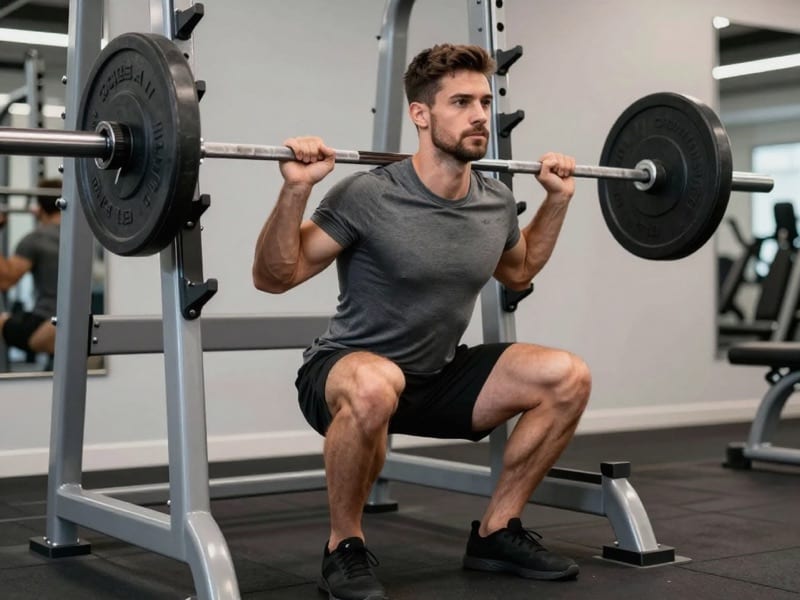
| Barbell Back SquatAfter warm-up sets, do 5 working sets at ~80–87% of your max with 1–2 reps in reserve. Squat in a rack with the safety pins set just below your bottom position, brace before every rep and sit to at least parallel. When you get 5 reps on every set, add 5–10 lb (2.5–5 kg) next time. | 5 × 3–5 | 3 min |
| Barbell Bench PressMedium day: ~72–78% of max with 2 reps in reserve. Pause each rep for a beat on your chest so you own the bottom position. When you get 4×6 with clean pauses, add 5 lb (2.5 kg). | 4 × 5–6 | 2.5 min |
| Seated Cable RowHeavy but strict: chest up, pull to your belly and squeeze for 1 s without leaning back. A strong upper back keeps the bar steady in the squat and bench. | 4 × 6–8 | 2 min |
| A1 Lying Leg CurlHypertrophy block: lower the weight over 2–3 s. The last set can go to failure. | 3 × 8–12 | — |
| A2 Face PullHelps keep your shoulders healthy under heavy pressing. Pull toward your forehead with your elbows high and finish with your hands beside your ears. | 3 × 12–15 | 90 s |
| Farmer's WalkUse the heaviest dumbbells you can carry while standing tall. Trains grip and bracing, which help on heavy RDLs and squats. | 3 × 30–40 s | 90 s |
Wednesday Bench: Heavy Bench Day
Heavy bench, Romanian deadlift, pull-ups · about 70 min
| Exercise | Sets × reps | Rest |
|---|---|---|
| Barbell Bench PressHeavy day: ~82–88% of max with 1–2 reps in reserve. Use a spotter or set the safety arms. When you get 5 reps on every set, add 5 lb (2.5 kg) next week. | 5 × 3–5 | 3 min |
| Romanian DeadliftPush your hips back with soft knees and keep the bar close to your legs. Lower until your hamstrings are fully stretched while your back stays flat, and keep 2 reps in reserve. Straps are fine on the top sets. When you get 4×6, add 5–10 lb (2.5–5 kg). | 4 × 5–6 | 2.5 min |
| Assisted Pull-UpUse the least assistance that still lets you do 4–6 clean reps from a dead hang. Once you get 4×6 with little help, switch to bodyweight pull-ups, then add weight with a dip belt. If you can already do 6+ strict pull-ups, skip the machine and go straight to weighted ones. | 4 × 4–6 | 2 min |
| Bulgarian Split SquatHold dumbbells and set your front foot far enough out that you can sink deep. Builds single-leg strength for the squat and helps even out left-right differences. Keep 2 reps in reserve so your legs recover for Friday's squats. | 3 × 6–8 per leg | 90 s |
| A1 Overhead Cable Triceps ExtensionHypertrophy block: let your hands travel well behind your head for a deep triceps stretch. Stronger triceps help your bench lockout. | 3 × 10–12 | — |
| A2 Dumbbell Biceps CurlKeep it strict with no swinging. Take the last set to within 0–1 reps of failure. | 3 × 10–12 | 90 s |
Friday Volume Day
Squat volume, glutes, incline press, dumbbell rows · about 70 min
| Exercise | Sets × reps | Rest |
|---|---|---|
| Barbell Back SquatVolume day: about 10% lighter than Monday's working weight (roughly 70–75% of max), with 3 or more reps left in every set. Every rep should be fast and identical, with the same depth and the same bar path. Add weight here whenever Monday's weight goes up. | 4 × 5 | 2.5 min |
| Barbell Hip ThrustLoads your glutes and hip extension hard with little lower-back stress, which matters after squatting. Keep your chin tucked and ribs down, and pause 1 s at the top. | 3 × 6–8 | 2 min |
| Incline Dumbbell PressSet the bench to about 30°. Builds pressing strength through a longer range of motion and gives your shoulders a break from the barbell. | 4 × 6–8 | 2 min |
| One-Arm Dumbbell RowGo heavy: brace on the bench, pull toward your hip and don't twist your torso. | 4 × 6–8 per arm | 90 s |
| A1 Lateral RaiseHypertrophy block: go light and strict and lead with your elbows. Builds the side delts, which pressing doesn't hit much. | 3 × 12–15 | — |
| A2 Captain's Chair Knee RaiseCurl your pelvis up instead of just lifting your knees, and don't swing. When 15 reps get easy, lower your legs over 3 s or raise them straight. A strong trunk gives you a steadier brace under the bar. | 3 × 10–15 | 90 s |
Cardio after: Stationary Bike, 5–10 min easy (optional). An easy cool-down spin. Cycling tends to interfere with strength gains less than running, so it's a good cardio choice on this plan. For heart health, add 2–3 easy 20–30 min rides on off days.
How to progress
- Double progression: add reps within the range first. When every set reaches the top of the range with clean form, add a little weight (about 5–10 lb on lower-body lifts, 2.5–5 lb on upper-body lifts) and start again at the bottom.
- Stop most sets 1–2 reps short of failure. Beginners stop 2–3 reps short for the first weeks.
- Every 6–8 weeks, or when you feel run down, take an easier week: half the sets, same weights.
Food
Eat at maintenance or in a small surplus (about +200–300 kcal) with 1.6–2.2 g of protein per kg of body weight (0.7–1 g per lb), because strength climbs fastest when you're not dieting.
Find your numbers with the free TDEE calculator, the macro calculator and the protein calculator.
Similar programs
-
 Movie-star plan
Action HeroBig shoulders, chest and arms on a lean body5 days/wk · 12 wks · Intermediate · Men
Movie-star plan
Action HeroBig shoulders, chest and arms on a lean body5 days/wk · 12 wks · Intermediate · Men -
 Movie-star plan
Lean & ShreddedShredded for a role: circuits and daily cardio5 days/wk · 8 wks · Intermediate · Everyone
Movie-star plan
Lean & ShreddedShredded for a role: circuits and daily cardio5 days/wk · 8 wks · Intermediate · Everyone -
 Model plan
Cover ModelLean and defined: abs, shoulders and arms5 days/wk · 8 wks · Intermediate · Men
Model plan
Cover ModelLean and defined: abs, shoulders and arms5 days/wk · 8 wks · Intermediate · Men -
 Chest Like ArmorChest twice a week from every angle, with nearly as much back work.4 days/wk · 12 wks · Intermediate · Men